
Society & Village Life of our Ancestors
The Great Swabian Trek
Village Life
Healthcare & Illness
Geography & Natural Disasters
Schools & Education
Clubs, Associations, Recreation & Sports
Local Administration
Ethnic & Religious Diversity
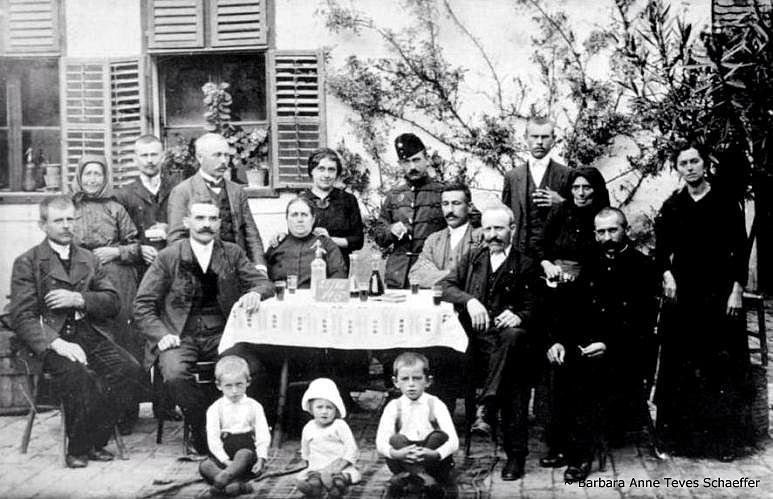
Card players in Doroslo. The handsome gentleman second from right at the table is Johann Reiter my grandfather.
~ Barbara Anne Teves Schaeffer
The Danube Swabian/Donauschwaben society began during the Swabian Migrations that came to be known as “Der Grosse Schwabenzug” or “The Great Swabian Trek” which occurred in three intervals between the years 1722-1787. You’ll find detailed information and drawings of centuries old architectural plans representing various village plans, property lots, house and floor plans, and the cost of building a house,
This series takes a walk back in time inside the simple way of life of our Danube Swabian ancestors. Learn about our ancestors “Village Life” as they knew it: front and back courtyards, gardens, hand tools, vintage lighting to home furnishings; and the heart of the home “the typical Swabian kitchen.” See where your ancestors drew their water from, the well & Schwengelbrunnen. Read about the points of interest of the village like the village railroad and the Hutweide (Community Meadow).
Health Matters & Living Conditions
School affairs and the German Public School
Climate, Rivers, Floods & Vintage Newspaper Articles
The Germans in Beschka were very happy to join clubs. On the one hand their established association served to care for the German customs, especially the German songs and literature. On the other hand the associations served as the fulfillment of the community’s problems, such as the Fireman’s Association.
Military borders, The Community House, Judge & Jurors, Political Positions, the Community Notary,
Living Together with Other Nationalities and Denominations
“Mein Heimatland, Banaterland”
Originally a poem written by Peter Jung was set to music by Josef Linster and Wilhelm Ferch.
Last updated: 11/08/2026