
DEATH & FUNERALS
OF OUR ANCESTORS
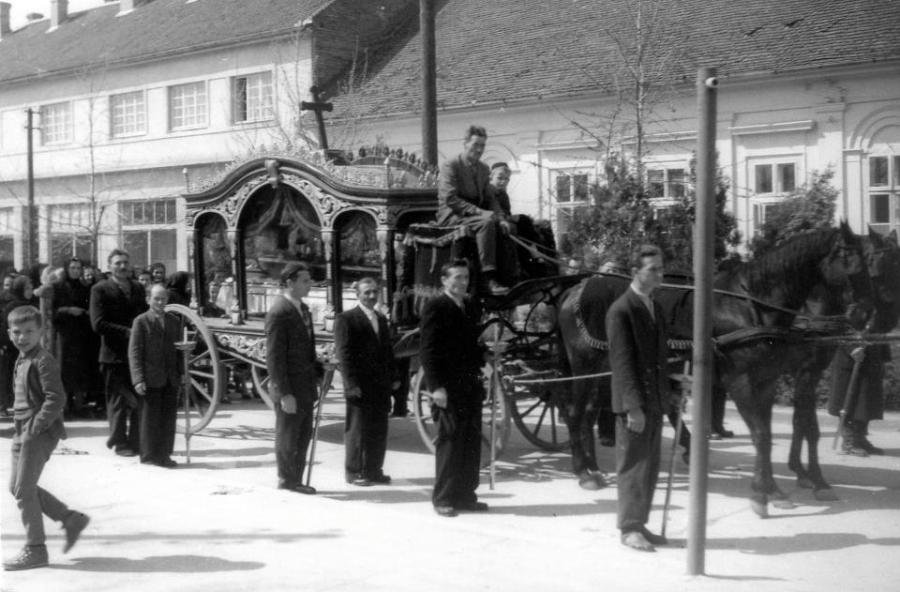
My great grandmother is at back all in black to the left. ~ Elizabeth Renate Jenki
The rosemary plant also had a role as a sign of mourning. That is why the mourners and many members of the village community paid their last respects to the departed by dipping the rosemary branch available on site into holy water, and then sprinkle the body of the dead person in a cross-shaped motion. Sometimes a rosemary bush was planted on the grave, as a symbol of eternal life. (Rosemary in the Life of the Danube Swabians, by Hans Gehl)
Laying to Rest in Semlak link to not
by Rose Mary Keller Hughes
At Funerals
by Peter Lang
Translation by Brad Schwebler
It is worth mentioning that before there was a hearse it was an honor to be invited to carry the casket. At the burial there were very many parts to be taken. It was especially beautiful when the pastor read about the life of the deceased. One learned to know the relationships of relatives from it. Some names in the ancestor register in this book are known to me from these courses of life. Important incidents from the lives of the dead the pastor used in his eulogy with all the skill of a Retoriker? (speaker) and hardly a dry eye remained in the bereaved community.
When the funeral procession went from the house of the dead to the cemetery they closed their shops as soon as it was within hearing distance (when they heard choral singing.) In some cases the music band also played funeral marches. One did not go into the church with the coffin. Everything was carried out of the bereavement house and to the grave.
During both wars a funeral service was also held for the fallen heroes, and nobody did not participate in it. It was really a people’s community in need, joy, and misery.
On Sundays, one half hour before the church service the men assembled in front of the church and exchanged news. The women went straight to their seats on the left side of the church, all the way up front were the young girls, in the middle were the young married women, and behind them were the old. With the men it was reversed. In the front on the right side in the two special benches sat the presbyters (elders) with the church inspector at the center, then came the seats for the old men and behind them sat the single boys. But when a stranger did not keep this order, he was not disturbed.
Undertakers’ Association
by Dr. Viktor Pratscher
Translated by Brad Schwebler
This association came into existence in 1893 at the suggestion of several village inhabitants by teacher Wilhelm Pratscher.
With the financial assistance from men such as Jakob Knittel, teacher, Peter Gutwein, Karl Gutwein, Karl Spengler, Adam Schwebler Jr., Peter Burger Sr., and Josef Pal, teacher, soon 600 members could be recruited.
The association existed for the purpose for different members to be buried in a respectable manner, whose heirs with a premium to contribute and to support any possible impoverished association members in illness and accidents. In 1893 a company in Sombor still made the hearses which are still in use today. The wagons were put up in a shed (Schupfen?) which stood from 1893 to 1928 on what is today’s new street and after that on the present site not far from the sporting ground.
Each one of the members had an entrance fee of 1 Kronen, 20 Heller and after each member died 20 Heller was paid. The premium was set at 35 Guilders. Soon the premium could be raised to 80 Guilders and to 90 Guilders in 1906. Also the fortunes increased from year to year. Yet (geriet?) the further joining of members in stocks, which according to the statutes the new members up to then gave contribution – or 20 Kronen – which they received later. This difficulty was remedied in such a way in 1906 that the premium for a new member was 20 Kronen less than it was for old members. The number of members added up to 1000 because of it. So 140 (bezügw.?) 120 Kronen per body was paid out and the total fortune reached the sum of 18,000 Kronen by the year 1914. During the war the fortune was lost to war loans.
First in the year 1922 the contribution was raised from 20 Heller to 1 Kronen and the premium to 900 Kronen. This was soon changed over from one Kronen to one Dinar. Because of the difficulties of the permissions and often necessary modifications of the statutes still always existed, the association connected itself to the Rural Welfare Cooperative in 1933 in Novi Sad-Neusatz and formed a village group at the time in this so-called wave. As members’ contributions were handed in the “wave” was 2 Dinar, 40 Para?” per year. After 1000 members it was 2400 Dinar.
The association still works today as it did 43 years ago. When 2, 3, or 4 members are dead, the server collects the contributions, the premium was paid from it, and the rest served as payment to the servers, the carriage drivers, and to other expenses. At the time the server received 50 Dinar per body, the hearse drivers received 20 Dinar per body. The office holders held their offices in an honorary capacity and were always elected every 3 years.
Before the German Reformed church stood a post where if an association member died, a mourning flag was hoisted.
The founder of the association was teacher Wilhelm Pratscher. According to minutes number 32 he is to be thanked for its establishment.
The office holders until now were the following:
The folk club was established in 1902. It’s home was in the guesthouse of Karl Paul from 1902 to 1905 after which it was at Johann Schmidt’s home. This club had 100 permanent members, mainly from the business trades and the small homeowners. It usually ordered 6 to 8 newspapers. The library numbered over 100 volumes which the village group of the cultural association had acquired and still fulfill this task today. The negotiation writings were drawn from a regulated activity. The club was left open after the war.
Office holders of the club were:
YEAR CHAIRMAN SECRETARY TREASURUER
(Table)
Up to August 1935, 654 members have died. So many needs and miseries could be relieved by this association in its 43 year existence. It also liked to do beneficial works over a wide area.
Life and Death
(Statistics/Sathmar) by Stefan Schmied
Translated by Gerald “Jerry” Thomas Boyle
Professor Dr. Stefan Vonhaz has established, in his eminent work about the settlement of the Sathmar Swabians, that during the 18th Century 2,000 families settled in 30 communities. The number of German inhabitants in these towns was around 18,000 in 1821, rose to 38,000 in 1912, and in 1930 was over 40,000. The population increased in one hundred years by more that 100%. At the turn of the century, the birth rate began to drop, as we can see from the following figures for every 1,000 inhabitants:
Year Births Deaths Population increase
(Births minus deaths)
1909 57.0 26.8 30.2
1910 60.5 33.8 26.7
1911 54.3 32.7 21.6
1912 58.6 23.2 35.4
1913 47.8 27.3 20.5
1931 39.6 22.3 17.3
1932 39.7 21.3 18.4
1933 36.8 21.6 15.2
1934 38.5 21.4 17.1
1935 36.6 21.1 16.5
Former Judge Gherman gives us these figures from the Grosskarol district for 1934-1936, comparing Germans with other nationalities per 1,000 inhabitants:
In proportion to the number of inhabitants, therefore, the Germans had an annual increase of 225, the Romanians 168, and the Hungarians 40. The above tables show that the Swabians had the greatest number of infant mortality.
Nationality Births Deaths Increase
German 35.3 20.9 14.4
Romanian 28.5 16.1 12.6
Hungarian 26.9 19.5 7.4
What about Scheindorf?
The settlement of 800 recorded in the years 1925-1934: 288 births, 194 deaths, and an increase of 94 souls. The corresponding figures for 1935-1943 were: 270 births, 160 deaths, and an increase of 110. Translated to figures we have the following picture, per 1,000 inhabitants:
Infant mortality in Scheindorf was also relatively large. Of the 26 registered deaths in 1937, there were 9 children. In 1938; 9 adults and 5 children died; in 1939, 13 adults and 6 children; in 1940, 10 adults and 8 children; and finally in 1943; 12 adults and 8 children.
In spite of the calculated increase in population, the number of people in Scheindorf did not increase during the ten-year period, because the town was affected more than all the other Swabian settlements by emigration because of economic need.
Births Deaths Increase
1925-1934 36.0 24.2 11.8
1935-1943 37.5 22.0 15.5
Cemeteries
by Dr. Viktor Pratscher
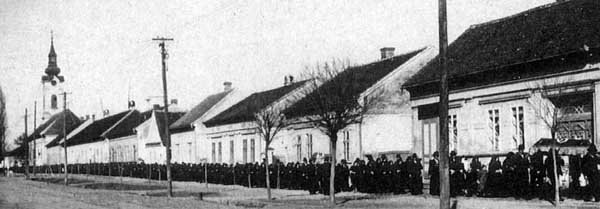
Funeral Procession- in Neu-Passau
The Bell and the Tower Clockby Dr. Viktor Pratscher
(For funerals the bells rang together for an hour and for half an hour beforehand the large bell rang first. During the funeral procession to the cemetery the bells rang together and likewise from the cemetery to the church for the eulogy.)
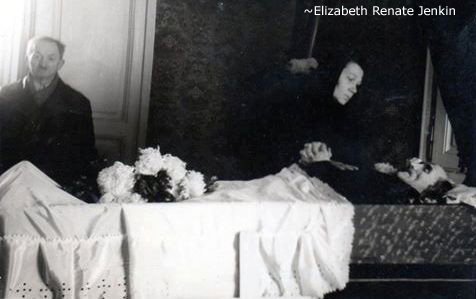
Jenkin Funeral
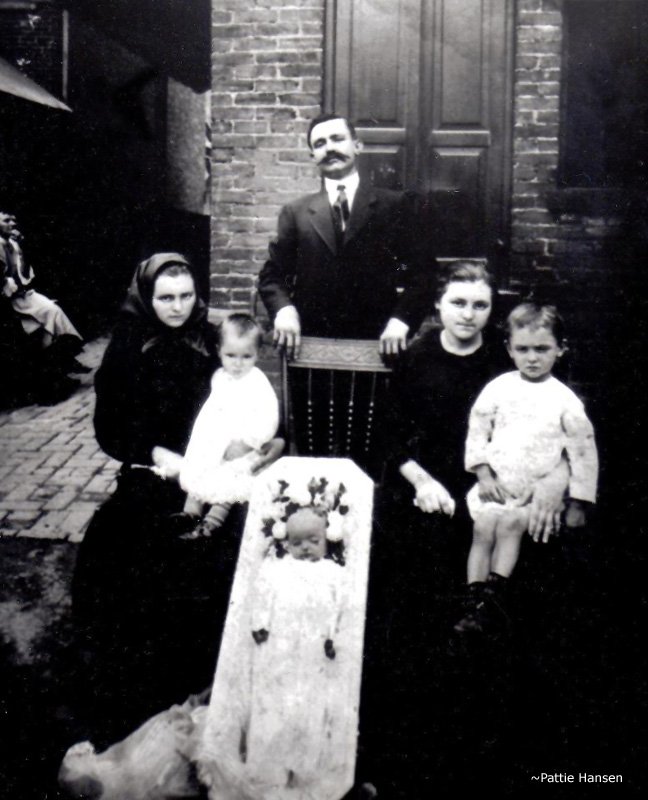
My grandfather Peter Ochs and his wife, Katarina Stumpf, 3 months after arriving at Ellis Island on July 3, 1914 from Hrastovac and settling in Pennsylvania. Grandmother holds her eldest son, Peter. Her sister Anna, later Anna Naas, holds the younger boy John (Ivan). Their eldest daughter, Katarina, had just succumbed to measles. As was the custom, a funeral portrait was taken. An unhappy moment but iconic, I believe. Clearing out my mother’s photos (she passed away in 2009) I find that her family continued the tradition of a funeral photo, although not a family portrait. Seems they always had to take a snap of the deceased in their coffin. ~ Pattie Hansen

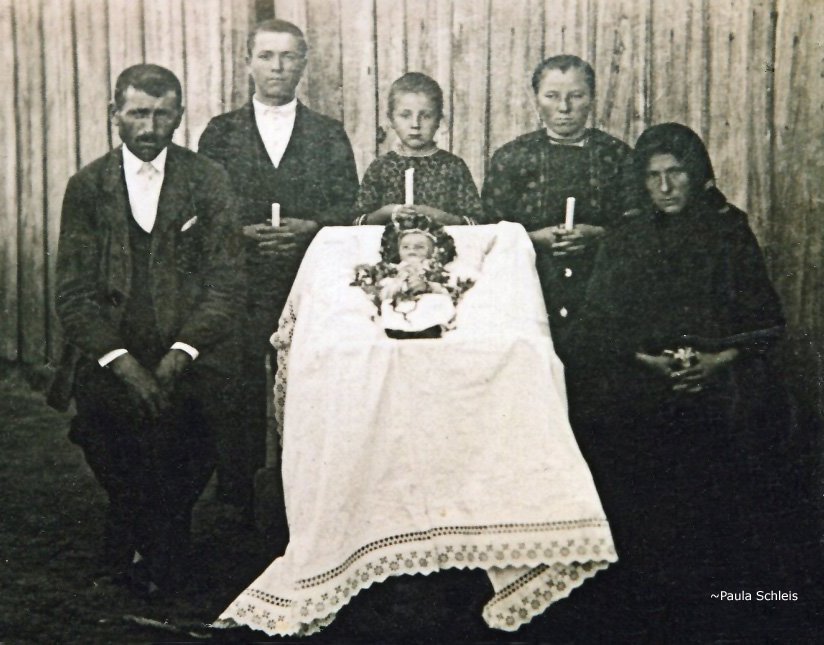
I have several photos of dead family members. This tradition of photographing the dead even extends into modern times — I had a Donauschwaben-born cousin in Chicago whose funeral I could not attend in the 90s, so the family sent me a thank you card for my sympathy card and included a picture of him lying in his casket as if it were no big deal. Was this tradition widespread in Europe or was it special to the Germans? Why did they do it? Anything you can share would be appreciated!~Paula Schleis
Funeral procession Daniel Sigmund murdered 1942 by the Partisans
(Military and Death, Obresch) Link not found
Last updated: 11/10/2026